
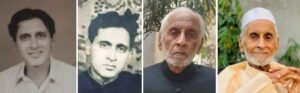
By M Ghazali Khan
I am on a British Airways flight to Delhi. Usually, I sleep well during journeys. But today, with the passing away of my father, Abdul Aleem Khan, in my hometown, Deoband, I have lost my sleep. I feel as if I am suffering from sleep apnoea. The only way I can find solace is by praying for him, writing about him, and talking about him. Having posted a piece about my father in Urdu, I am now rendering my memories in English.
Like many expatriates, I, too, have had to pay another heavy price today. In December 2019, I paid this price by being unable to attend my mother’s namaz-e-janazah. Today, I have been deprived of the opportunity to attend my father’s janazah prayer. On 13 December 2019, I had my last glimpse of my mother through a video call from Heathrow Airport. Today, I had to see my father for the last time as well — lying in his coffin, ready to be taken to his final resting place — through a video call.
The entire film of my life, from childhood to today, played before my eyes. Whenever I travelled to India, my sole purpose was to spend as much time as possible with my parents. On every journey, my heart longed to reach them as quickly as possible so I could be with them.
After my mother’s passing, I had the consolation that I would still be able to meet my father. But today’s journey feels indescribable. Sadness, emptiness, concern about reaching my younger siblings as soon as possible to comfort them, and a strange trembling in my heart fill me. Then I find some peace by reminding myself that, sooner or later, everyone has to leave this world.
My father lived a clean, transparent, and dignified life. Allah Almighty blessed him with a beautiful ending. While listening to Surah Ar-Rahman, he kept repeating:
‘Fabi ayyi ala’i rabbikuma tukazziban’
(‘So which of the favours of your Lord will you both deny?’)
And while reciting kalima, he surrendered his soul to the Angel of Death.
Last year, on Father’s Day, I posted a piece on Facebook. In December 2025, when I was in Deoband, I do not know what came over me, but I printed that article and gave it to him. By then, dementia had already affected him significantly. I do not know what impression those words made on him. He looked at me and simply said:
‘If I ever made any mistake, forgive me.’
Even today, I do not understand how I managed to control my emotions at that moment. I belong to a generation that never even spoke loudly in front of our parents, let alone embraced our fathers. But at that moment, I lost all restraint and hugged him.
Like many marriages of that era, my parents’ marriage was early, too. As a result, there were only about four or five years between my late younger chacha, my late and only phoopi, and me. Seeing them, I also began calling my father ‘Bhaijan’ (elder brother), and I always addressed him by that name.
Bhaijan was an old Aligarian, a true representative of Aligarh’s old values. Although he was a farmer by profession, he was a teacher by nature.
Among the six siblings, he sent none of us to a madrasa, nor did he hire a tutor to teach us the Qur’an. After the Fajr prayer, his daily routine included teaching us the Qur’an, books such as ‘Rasool-e-Arabi’, ‘Khulfa-e-Rashideen’, and ‘Taleem-ul-Islam’, along with English lessons.
Once, I asked him what he would have become if he had not been a farmer.
‘Perhaps a university lecturer, because it is a career in which one’s knowledge continues to increase, and a person remains young by staying among young people.’
That was his answer.
Bhaijan was always passionate about cricket. He was unhappy because I did not take part in sports. At the time, I did not understand it, but now I realise that, because of my dyslexia, I was never able to catch a ball properly and, as a result, I lost interest in sports.
Near our house, there was a small field belonging to my maternal grandfather, where children and young people from the mohalla used to play cricket in the evenings. (The residents of this mohalla all belong to the same family and are relatives.) They had formed a club called the ‘Afghan Cricket Club’. Bhaijan would often go there and begin coaching them properly. In fact, he would also join in himself, taking part in both bowling and batting.
As long as his memory remained strong, he had an encyclopaedic knowledge of cricket.
In the 1980s, India and Pakistan were playing a series. Javed Miandad was scoring runs one after another. At that time, television had not yet reached Deoband. I remember Bhaijan sitting with friends and listening only to the radio commentary when he commented:
‘He scores runs well, but he lacks beauty in his batting.’
His friends laughed a lot at this remark.
Bhaijan regularly subscribed to ‘Indian Express’, ‘Illustrated Weekly of India’, and the Bombay-based magazine ‘Sports World’, published under the editorship of Nawab Pataudi. When the next issue of Sports World arrived after this incident, Nawab Pataudi’s editorial contained exactly the same observation. Bhaijan proudly showed that editorial to his friends as proof.
In Aligarh, apart from perhaps being a Hall cricket captain, he was also an active member of the riding club. I vaguely remember seeing him playing cricket matches in Deoband during my childhood and occasionally playing volleyball.
Those were simple days. Even well-off farmers did not consider it beneath their dignity to drive their own tractors in their fields. Bhaijan did this himself as well.
I was in the eighth grade when Bhaijan taught me to drive a tractor and a motorcycle. I used to happily drive the tractor around the fields.
Although he was a farmer, he was very particular about his dress code. When he was not working in the fields, no one looking at him could believe that he was a farmer.
Once, my close friend and classmate, Waseem Ahmed Qadri (now a Senior Advocate at the Supreme Court of India), came to Deoband with me. As we neared our house, we saw Bhaijan, smartly dressed, riding his Escort 47 tractor—although he had never used a tractor as a means of transport, and obviously going to the fields dressed like that was out of the question.
When I told Waseem that he was my father, he jokingly said:
‘He looks more like a model for the Escort company than a farmer.’
After I passed high school in 1974 and enrolled in the PUC programme in Aligarh, the entire scene from the day before my departure keeps coming back to my mind. He was teaching me how to tie a tie.
Before that, he explained Aligarh’s traditions and culture to me. Alongside this, he gave me another important piece of advice:
‘The purpose of joining a university is not only to earn a degree but to expand one’s knowledge and views. This comes from meeting people from different places, learning something from them, and sharing something with them.’
Then he gave me a warning:
‘Even after joining the university, if your priority remains to befriend students from your own town and district only, I will call you back and get you admitted into a local college.’
This advice proved so valuable throughout my life that I developed a deep dislike for regionalism and narrow-minded attachment to one’s own district and culture.
Through my grandparents’ teachings and by Allah’s grace, Bhaijan always remained committed to prayer and fasting. However, he stayed far away from what is commonly called religiosity in the social sense.
I was in the final year of my B.A. when my classmate and very close friend, Syed Asim Ali, who later became a Professor in the Department of English at AMU, encouraged me to read some of Maulana Abul Ala Maududi’s writings. Asim had read many books by Maulana Maududi because of his father’s association with Jamaat-e-Islami.
I borrowed one or two books from him and went home to Deoband during the holidays. At that time, hostility towards Jamaat-e-Islami in Deoband was so widespread that many people today may not even be able to imagine it.
When my late grandfather and late uncle saw Maulana Maududi’s books with me, they became concerned. However, beyond expressing their displeasure, they did not react strongly.
Unlike them, Bhaijan looked at the books, flipped through a few pages, and then said:
‘Beta, reading books is a good thing. Read whatever you like; I have no objection. But keep your mind open and never wear the glasses of any particular group or organisation.’
Both of these pieces of advice have remained extremely valuable throughout my life.
Once, my younger brother mentioned, in Bhaijan’s presence, a favour he had done for someone. Bhaijan became extremely upset and said:
‘All of you, bear this in mind. If you do not have the ability to do someone a favour and then forget about it, do not do anyone a favour at all.’
On another occasion, while expressing my displeasure at someone’s behaviour, I mentioned, in his presence, a great and extraordinary favour he had done for that person.
But instead of feeling happy at being praised, he reacted as if I had reminded him of something sinful. His posture changed, and while repeatedly seeking forgiveness from Allah, he said in a strange and emotional way:
‘I have done nothing for anyone. I have done nothing for anyone. Do not ever mention this on your tongue again.’
For him, reminding someone of a favour he had done was a great humiliation and disgrace.
My late mother often used to tell me that when I was very young, I suffered from such a severe case of typhoid that there was little hope that I would survive.
The remarkable thing is that my mother never described what she herself went through at that time. But whenever she narrated this incident, the tears in her eyes clearly revealed the pain and suffering that a mother experiences in such circumstances.
She would always mention Bhaijan’s prayers — how he would pray for me with such deep anguish and longing. I recovered from the illness but lost the ability to walk.
It was the 27th night of Ramadan. According to my mother, that night Bhaijan prayed and made supplication while sitting on a takht. His state was such that, because of the intensity of his crying, trembling, and pleading before Allah, the very platform on which he sat and prayed was shaking.
Being the first grandson, I was very dear to my grandparents. But seeing Bhaijan’s condition, even they could not control their tears — despite my grandfather being a man of exceptionally strong nerves and courage.
Anyway, as was the usual routine, after the Fajr prayer, everyone in the house went to sleep.
In the morning, my father suddenly woke my mother up with great happiness and said:
‘Look there!’
Look there!’
My mother looked in the direction he was pointing and saw me standing and walking.
The prayers of a father, the tears of a mother, and the blessings of Allah had brought about a miracle.
He left no stone unturned in ensuring the education, upbringing, and character development of my siblings and me. He taught me the Qur’an, introduced me to various books, encouraged independent thinking, and prepared me to face the world with confidence.
As I look back today, I realise that much of what I am is because of him. His lessons were not limited to words; his entire life was a lesson. His simplicity, humility, honesty, generosity, and commitment to principles shaped the lives of all his children.
He taught us that faith is not merely a matter of outward appearance but a way of living. He showed us that knowledge should make a person humble, not arrogant; that helping others should be done quietly, without expecting recognition; and that a person’s real worth lies in his character.
My father is no longer physically present, but his teachings, his values, and his prayers will remain with us forever.
A father’s departure leaves a void that can never truly be filled. But the memories of a father who lived with dignity, served his family with love, and left behind a legacy of goodness become a source of strength for those who remain.
May Allah Almighty forgive all his shortcomings, elevate his status in the Hereafter, illuminate his grave, and grant him the highest place in Jannah.